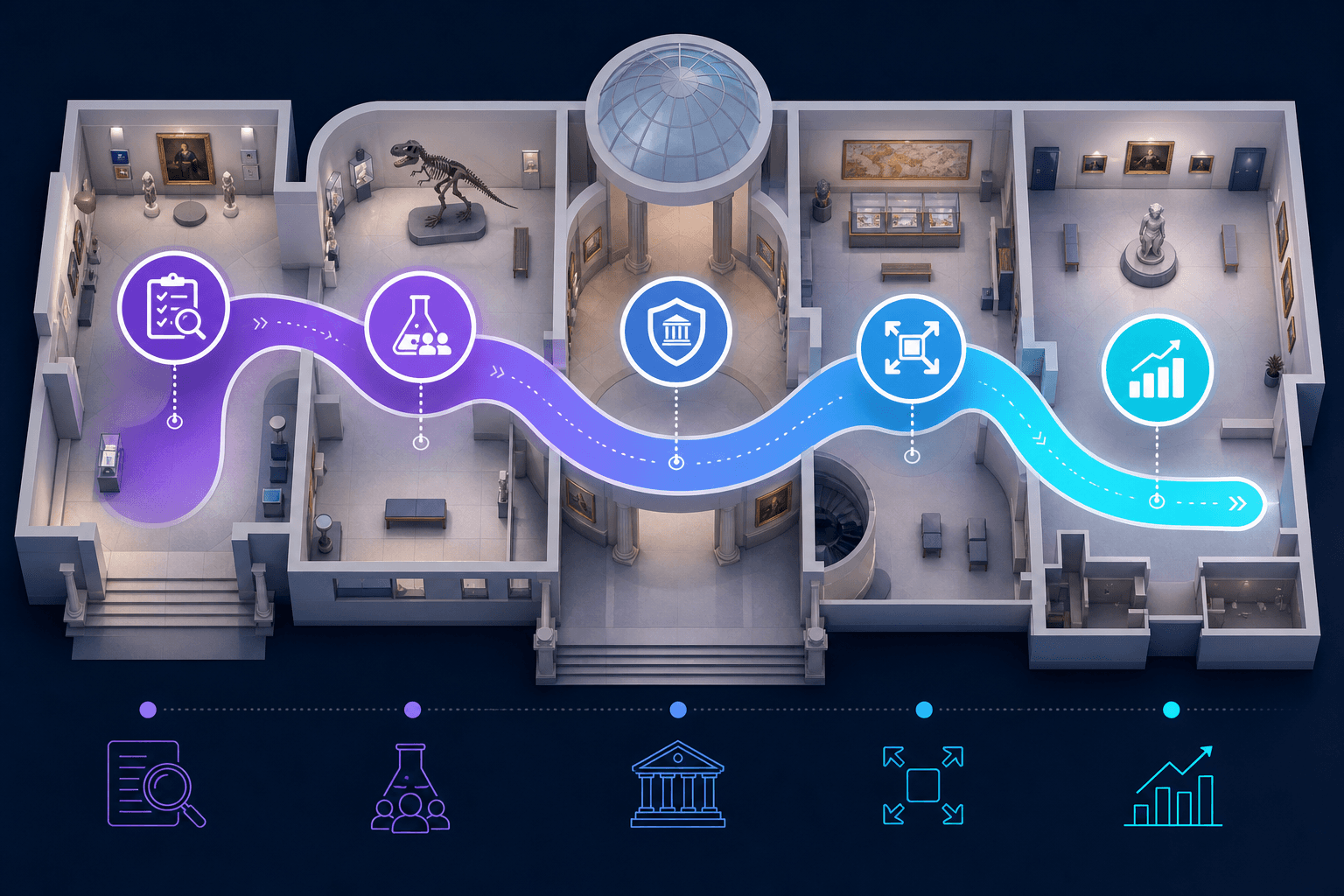
"Digital transformation" in museums has meant many things over the past twenty years: a new website, an collections database upgrade, a mobile app that launched to fanfare and quietly stagnated, a QR code linking to a PDF of a label. Each project delivered something useful. Few delivered a scalable, measurable visitor layer that curators trust and leadership can fund with confidence.
The AI era raises the stakes. Generative technology makes interpretation faster to produce and easier to personalise, but also easier to get wrong in public. For museum directors, transformation leads, and heads of digital experience, the strategic question is no longer whether to digitise. It is: how does your institution turn approved knowledge into a governed visitor experience that scales across galleries, languages, and funding cycles?
This guide outlines a practical roadmap, not a vendor pitch, but a sequence of decisions that institutions can adapt regardless of which technology they ultimately choose.
Stage 1: Audit what you actually have
Before planning what comes next, document what is live today. Most museums discover they are running several overlapping systems nobody has mapped together:
- Audio guides: Handsets, apps, or third-party tours with separate content pipelines
- Mobile apps: Installed by a fraction of visitors; often outdated between release cycles
- QR codes: Linking to web pages, PDFs, or videos with inconsistent quality
- Third-party apps: Consumer platforms (Smartify, Bloomberg Connect, etc.) with varying governance
- Nothing digital on the floor: Labels and human guides only
For each system, capture:
| Dimension | Questions to answer | |-----------|---------------------| | Reach | What percentage of visitors actually use it? | | Content ops | How long to update when an object moves or a label changes? | | Languages | Which languages are covered, and at what cost per language? | | Governance | Who approves what is said, and can you audit it? | | Analytics | What engagement data reaches leadership or funders? | | Accessibility | Is it inclusive by design or bolted on? | | Total cost | Hardware, licences, content, staff time, over three years |
This audit often reveals that the institution is paying for multiple partial solutions that together cost more than a unified platform would, while serving fewer visitors well.
Stage 2: Decide what information is worth digitising first
Not every object deserves equal digital investment. Start where impact is highest:
- High-traffic galleries: Where visitor density and question volume are greatest
- Funding priorities: Exhibitions tied to grant outcomes or strategic plans
- Interpretive gaps: Objects visitors ask about but labels cannot fully address
- Multilingual demand: Galleries where language accessibility is a statutory or strategic obligation
- Temporary exhibitions: Where fresh content is expected and the clock is visible
Resist the urge to digitise the entire collection before piloting. A focused corpus (approved, curated, maintained) produces better visitor answers than an exhaustive one that is stale.
For operator teams, the digitisation question connects directly to admin workflows: who uploads content, who approves it, how often it is reviewed, and how analytics feed back into programming decisions.
Stage 3: Align stakeholders before you align technology
Digital transformation fails more often from organisational misalignment than from technical limitations. Before selecting any platform, secure explicit agreement from:
- Leadership and board: What metrics define success? Visitor satisfaction, dwell time, reach, inclusion, revenue?
- Curators and interpretation: Who owns the approved knowledge base? What is the sign-off process?
- Digital and IT: Integration requirements, browser compatibility, camera access, hosting, security review
- Front-of-house: Training, troubleshooting, equity provision for visitors without devices
- Legal and data protection: Privacy impact, retention, consent, accessibility compliance
Our stakeholder overview maps how different roles benefit from governed visitor AI. Use it as a conversation starter in cross-department workshops.
Stage 4: Define pilot criteria: small, governed, measurable
A good pilot is narrow enough to govern and broad enough to learn from. Recommended parameters:
- One gallery or exhibition: Bounded scope, clear content corpus
- One language pair minimum: e.g. English and Welsh, to test multilingual workflows early
- Approved content only: No open-web sources; citation trail required
- Browser-based access: QR to web, no app install, to maximise participation
- 90-day review: Fixed end date with predefined success criteria
- Named owners: One curator, one digital lead, one front-of-house champion
Success metrics might include: visitor uptake rate, satisfaction scores, questions asked per session, gallery coverage, staff support burden, and content update turnaround time. Anonymised analytics (sufficient for board reporting without profiling visitors) should be part of the pilot design from day one.
Stage 5: Scale with content workflows, not just technology
If the pilot succeeds, scaling is primarily a content operations challenge:
- Editorial calendar: Sync digital updates with exhibition changeovers
- Translation pipeline: Welsh-first or other statutory languages built into workflow, not added later
- Governance cadence: Monthly review of unanswered questions, errors, and visitor feedback
- Staff development: Interpretation teams skilled in configuring and refining AI, not just writing labels
- Platform reliability: Leadership will ask whether the system is dependable; transparent system status reporting builds confidence
Institutions that treat scaling as a technology purchase alone (more licences, more devices) repeat the app-store cycle. Institutions that invest in content ops and governance build durable capability.
Common failure modes to avoid
Learning from peer institutions, and from projects that stalled, these patterns recur:
App-store dependency
Native apps require updates, reviews, and visitor downloads. Participation rates rarely exceed single digits without sustained marketing. Browser-based access removes this friction entirely.
Ungoverned AI
Deploying consumer AI without approved sources creates reputational risk. One wrong answer is a news story. Governed AI with citations is insurance, not optional luxury.
No citation trail
If curators cannot verify why the system said something, they will not trust it, and they should not.
No visitor analytics
Without anonymised engagement data, you cannot report to funders, justify renewal, or improve content. Build measurement into the pilot, not after it.
Ignoring accessibility
Retrofitting accessibility is expensive and incomplete. Require it in the pilot specification.
Skipping front-of-house
Staff who feel surprised by technology will not support it. Include them in the pilot design and celebrate their role alongside digital interpretation.
Where AI fits, and where it does not
AI is a powerful layer for visitor-facing interpretation grounded in approved content. It is not a replacement for:
- Collections management systems
- Conservation documentation
- Acquisitions and research workflows
- Human-led tours, workshops, and community programmes
The strategic frame is augmentation: AI handles scalable, repetitive, multilingual interpretation; people handle what requires judgment, empathy, and presence.
Partner venues including National Museum Cardiff, Thinktank Birmingham, and the National Roman Legion Museum pilot are live references for what governed deployment looks like in practice. See our partners section for context.
A 90-day transformation sprint (summary)
| Week | Focus | |------|-------| | 1–2 | Audit existing systems; map stakeholders; define pilot gallery | | 3–4 | Agree success metrics; assemble approved content corpus; legal/accessibility review | | 5–8 | Deploy pilot; train front-of-house; monitor daily | | 9–12 | Review analytics; gather curator and visitor feedback; decide scale or iterate |
This sprint is achievable for most institutions without a multi-year programme office, provided the scope stays disciplined.
From strategy to your first governed pilot
Digital transformation for museum visitor experience is not about chasing technology headlines. It is about building a durable layer between your approved knowledge and your visitors: one that is accessible, measurable, multilingual, and under institutional control.
The institutions that get ahead in the AI era will not be those that moved first. They will be those that moved deliberately: with governance, with citations, with stakeholder alignment, and with a pilot design that produces evidence rather than anecdotes.